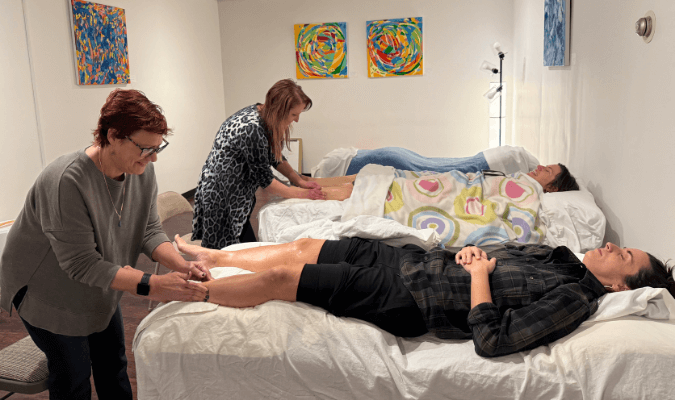
Reflexology works with the lymphatic system, an essential part of the body’s immune system that contains an extensive network of lymph vessels, lymph nodes, and the lymphatic organs as bone marrow, spleen, thymus, and tonsils, which create lymphocytes.
Reflexology for lymph drainage, using advanced protocols, can assist in removing excess lymphatic fluid, so it can be filtered and flushed out.
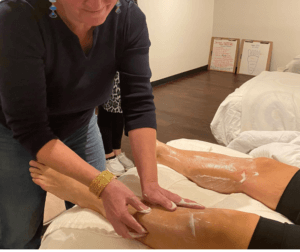
Every holistic reflexology session focuses on the cleansing and detoxification of the body, including extensive stimulation of the urinary system, lymphatic system, including the lymph vessels and lymph nodes, the digestive system, as well as strengthening the body’s defense system. As a result, clients often experience a physical and mental/emotional release as they receive the cleansing and detoxification reflexology.
In severe cases of swelling, a holistic reflexologist using the advanced protocols for lymph drainage can stimulate reflex points beyond the foot and work up the lower leg, stimulating specific reflexes for efficient lymphatic removal.
For clients suffering from lymphedema related to multiple sclerosis and leg injuries, reflexology can provide enormous benefits and symptom relief.
A Case Study of Reflexology for Lymph Drainage
For lymphatic drainage, holistic reflexology offers superior solutions to other healing and medical modalities, as the following client case demonstrates:
A young man suffered a boating accident, fell into the river and the boat’s propeller cut his lower leg deeply, creating potentially life-threatening injuries. The client was a trauma patient, level 2. During rehabilitation, he received physical therapy, sports massage, and lymphatic massage, which only provided minor relief.
Four months after the accident, desperate to find relief for the intense and painful swelling of the lower left leg and ankle, he researched Holistic Medicine and scheduled an appointment with me.
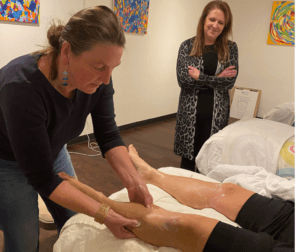
Our first session started with a comprehensive medical intake, and then the client lay down on my treatment table. The left leg was swollen to nearly double the size of the healthy leg. The deep cuts from the boat’s propellers left significant scarring. The skin felt hard to the touch, ready to burst. The swelling caused immense pain.
In the first session, I worked intensively on preparing all the cleansing organs for the excess work of removing the fluid from the body. The kidney reflexes and the entire urinary system were activated, the lymph node and lymph vessel reflexes on the foot, as well as the spleen and thymus reflexes and the digestive system.
Only then did I focus on gentle stimulation of the specific reflexes in the lower legs and around the ankles for cleansing and lymphatic drainage.
Following the reflexology session, the client felt relief, less pain, and more balance when he stood up. For this trauma-related swelling, reflexology for lymph drainage offered a gentle, noninvasive way to support the body’s own healing processes.
He came back a week later for his second appointment and exclaimed, “It is a miracle!”
The swelling on his left leg had nearly fully disappeared, and the leg was similar in size to the healthy right leg. The skin felt normal and flexible to the touch.
After ten weekly sessions, the client felt he had reached his health goals. He reported that he felt his leg was fully restored to pre-accident health. One of the main benefits he reported was that he was able to stand again for two days in a row at conferences, which he had been unable to do after the surgery.
Where other treatment modalities that were prescribed did not help this client with post-surgery relief, holistic reflexology did. This is because it’s a full system approach.
Why Did Reflexology for Lymph Drainage Work So Well for This Client?
First, this client case is not an exception. It is the rule in holistic reflexology.
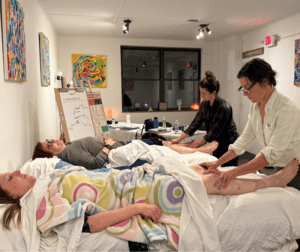
The secret to success in holistic reflexology is the activation of all the cleansing organs first, so they are ready for the excess work and have the capability to remove the fluids from the body immediately.
The holistic reflexologist literally stimulates the body’s internal functions and does not rely solely on external stimulation, as confirmed by scientific research. For example, many of my clients reported feeling unwell or experiencing a healing crisis after a lymph drainage massage.
The explanation? In lymphatic massage, excess lymph fluid that is moved during a massage has nowhere to go and so must be reabsorbed into the body. This is because the lymph nodes, the kidneys, and the cleansing systems were not prepared for the extra work. And often, the body simply cannot reabsorb that much extra fluid, which leads to extra client distress.
With holistic reflexology, we prepare these systems for the extra demand so the body can shed the fluid rather than trying to reabsorb it. We prepare the lymph nodes and the urinary system to flow it from the system, allowing for healing and increased well-being.
Reflexology Lymph Drainage for Lymphedema
This is why holistic reflexology is an excellent modality to address lymphedema, which can be caused by damage or removal of lymph nodes after cancer surgery and radiation.
Lymphedema is also caused by trauma, infection and obesity, and congenital lymphatic malformations. Reflexology can be used as a supportive modality alongside conventional care to help reduce swelling and discomfort.
Reflexology Lymph Drainage for Multiple Sclerosis (MS)
A scientific research study conducted at the Department of Orthopedic Rehabilitation, Complementary Medicine Clinic, Multiple Sclerosis Center at Sheba Medical Center in Tel-Hashomer in Israel, confirmed that reflexology relieves symptoms of Multiple Sclerosis.
Multiple Sclerosis is a chronic immune system disease in which the body attacks itself. In the case of MS, the myelin sheath, the protective layer that envelops the nerve fibers, gets damaged.
In my practice, holistic reflexology has been an important part of supporting a great number of MS clients. It eases
swelling and discomfort in the lower extremities, helps them regain balance, and eases their walking problems.
With a progressive disease like MS, it is important that the client makes holistic reflexology part of their regular health care regimen. The holistic reflexologist offers relaxation techniques to the client as a tool for coping with the disease. A deeper understanding of the client’s mindset is essential for optimal holistic care.
In a number of cases, I have witnessed that the onset of the disease was triggered by a significant trauma, e.g., an accident or a family trauma. I recall one example case study, in which my MS client’s father had died, and the siblings feuded over the inherited family business.
My client reported during her comprehensive holistic reflexology medical intake that by the time she was diagnosed with MS, she had felt the burnout and overwhelm of handling of the family business for a prolonged time. She couldn’t stand the constant stress of feuding with her siblings any longer.
In this case, the attacks among family members over a period of several years may be the mental-emotional component contributing to the onset of the DIS-EASE in the physical realm, where the body attacks itself.
A review of the Scientific Reflexology Research
Reflexology Relieves Symptoms of MS
Reflexology significantly improved paresthesia, urinary symptoms and spasticity in people with multiple sclerosis, according to recent research.
“Reflexology treatment relieves symptoms of multiple sclerosis: a randomized controlled study” was conducted by staff at the Department of Orthopedic Rehabilitation, Complementary Medicine Clinic and the Multiple Sclerosis Center at Sheba Medical Center in Tel-Hashomer, Israel; and the Gertner Institute for Epidemiology and Health Policy Research.
Seventy-one people with multiple sclerosis were randomly assigned to receive either reflexology or control treatment for 45 minutes once a week, for 11 weeks. Fifty-three of the subjects completed the study. Thirty-six reflexologists participated in the study, each treating one reflexology and one control subject.
The reflexology sessions consisted of manual pressure on specific points of the feet and massage of the calf area. The control sessions consisted of nonspecific massage of the calf area, a sham treatment to control for the effects of touch and relaxation.
Outcome measures were the mean intensity of paresthesias (sensory deficits), evaluated by the Visual Analogue Scale; urinary symptoms, evaluated by the American Urological Association symptom score; sum muscle strength of the iliopsoas, quadriceps, hamstrings and adductor muscles, each evaluated by the British Medical Research Council scale; and spasticity, evaluated by the Ashworth scale.
A masked assessment was performed before the study period; at the start of the study period; six weeks into the study; at the end of 11 weeks; and three months after the study period ended.
The reflexology group showed significant improvements at the end of the study period for scores of paresthesias, urinary symptoms and spasticity. Muscle strength scores for the reflexology group showed borderline improvement. The improvement in the intensity of paresthesia remained significant at the three-month follow-up.
Subjects in the control group showed no significant improvements on any of the outcome measures.
“It is of interest to note such positive effects of single intervention on a broad range of symptoms,” state the study’s authors. “Further clinical and laboratory studies are needed to validate these results and to understand the mechanisms by which reflexology improves symptoms secondary to [multiple sclerosis].”
Source:
Department of Orthopedic Rehabilitation, Complementary Medicine Clinic, Multiple Sclerosis Center at Sheba Medical Center in Tel-Hashomer, Israel; and Gertner Institute for Epidemiology and Health Policy Research. Authors: I. Siev-Ner; D. Gamus; L. Lerner-Geva; and A. Achiron. Originally published in Multiple Sclerosis, 2003, Vol. 9, pp. 356-361.
Living with Lymphedema, MS, or Lingering Leg Injuries?
If you are living with lymphedema, Multiple Sclerosis, or lingering leg injuries, reflexology for lymph drainage may offer holistic support alongside your medical care to improve comfort and quality of life. Always consult with your physician or healthcare provider before making changes to your treatment plan.