A higher consciousness, supported by a holistic mindset, is part of the professional discipline –and the ethics – of well-trained, effective holistic professionals.
The more regulated, self-aware, and internally honest the practitioner is, the safer and more effective the work becomes for the client. Codes of ethics in touch-based professions explicitly frame “do no harm” as encompassing the practitioner’s well-being, not only the client’s, because the practitioner’s state of being affects the session.
That’s why the best holistic practitioners treat their own healing as ongoing training and professional development. Professional standards across helping professions also recognize that when personal conflicts or unresolved material interfere with competence, practitioners should pause, seek support, and adjust their work accordingly. This is true across the spectrum of reflexologists, shamanic healers, energy workers, and beyond.
In this article, a holistic mindset means working with the whole human – their history, nervous system, emotions, body, and ancestral wounds – so the practitioner’s inner work becomes part of client safety, neutrality, and real transformation.
A Higher Consciousness Rooted in Emotional Balance
Emotional balance starts with strong roots and the relationship to mom and dad.
Through our parents, we receive the gift of life. How we come into this world shapes how we move through the world. It influences our strengths and our weaknesses.
For the holistic practitioner, this means they must first undergo profound inner work before touching another human being. A holistic practitioner who is driven by their own wounds and trauma cannot uplift a client to the next higher level of consciousness – and may keep both themselves and their clients stuck in trauma and pain.
Brauer Institute students learn to recognize their own blind spots and projections, enabling them to touch another human being from a place of love, inner peace, insight, and understanding. They must first tend to their own roots and ascend to higher levels of consciousness before assisting others on the path to healing and elevating awareness beyond trauma and pain.
Neutrality of the practitioner is essential to serve the client, and it is only possible when one has faced their own shadows and turned them into light. The first step to healing always includes building strong roots, then moving up the emotional scale and cultivating a state of inner peace that, over time and with practice, can be maintained consistently.
Over time, a higher consciousness becomes less an idea and more a practiced state of being.
One needs to understand the basic emotions, desires, and dominant driving forces in one’s life – and illuminate what is hidden – to practice from clarity rather than compulsion.
Using the Mother Wound to Create an Emotional Shift
For example, I have witnessed cases where clients with a deep mother wound were driven to immense success in the outside world, which translated to more titles and more degrees than anyone else. Their constant effort for validation – and the resulting stress and inability to rest – left them feeling a deep void of emptiness, as well as depressed and exhausted.
The underlying root cause of the need for recognition was a profound lack of self-esteem, shaped by feelings of abandonment by an absent mother in early childhood.
Reconnecting the client to their mother and understanding the ancestral pain often carried through the generations allowed them to shift into feeling that they are enough—and worthy of love.
Consequently, the chase for something outside of them was over, and they gained a sense of inner peace they had never experienced before.
A Brauer Institute holistic reflexologist is trained to read these emotional patterns from the client’s feet in the solar
plexus and root center areas, and to analyze the context of specific organ systems, which, in Traditional Chinese Medicine, are related to dominant and non-dominant emotions.
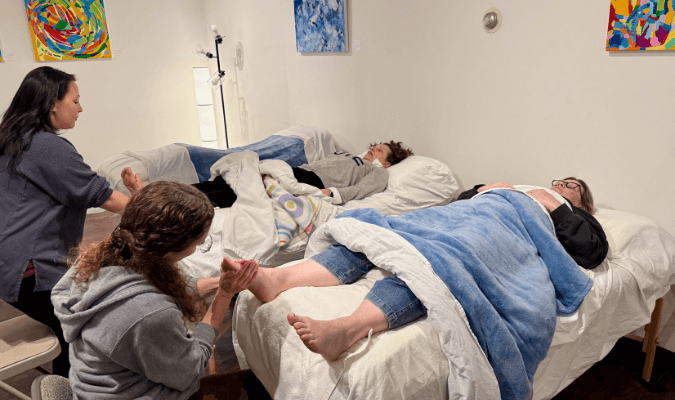
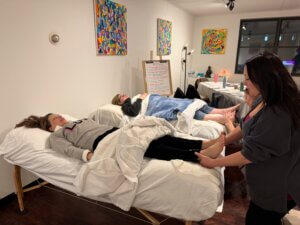
A skilled holistic reflexologist can read a client’s parental wounds in the client’s feet and assist in creating an emotional shift, which is then integrated on the physical level through touch. Then, specific reflexes in the feet – including the pituitary gland and vagus nerve reflexes – support heart-brain alignment and a shift in consciousness. In many cases, that shift is felt as a higher consciousness – more space, more clarity, and more inner peace.
The Three Essentials of Every Human Being
Every human being wants to be loved, to be seen, and to belong. And the root for how we meet these needs are formed during the first years of childhood at home:
- Safety and security
- Unconditional love
- Healthy boundaries and guidance
- Emotional stability
When these essentials are missing, the nervous system stays in survival, and the grounded stability that supports a higher consciousness can feel out of reach.
If a person doesn’t develop strong roots in these areas during their early years, they may search for them artificially throughout their whole life.
For example, a physical manifestation of a root center imbalance can be obesity or anorexia, as we sometimes see alongside addiction and compulsive coping patterns. Obesity can reflect a yearning for roots through adding physical matter; anorexia can reflect a yearning for roots through denial and disappearance. In both cases, the deeper longing is for safety, belonging, and the grounded roots that sustain this evoluation and transformation.
A higher consciousness is easier to access when the nervous system has a baseline of safety and regulation.
Emerging data show that many living in the United States are dysregulated and unrooted:
- The CDC estimates place obesity prevalence among U.S. adults at 41.9% (2017–March 2020), affecting more than 100 million adults. More recent NHANES reporting (August 2021–August 2023) estimates adult obesity prevalence at 40.3%.
- Based on 2024 data from the Substance Abuse and Mental Health Services Administration (SAMHSA), approximately 48.4 million Americans aged 12 and older (16.8% of that population) had a substance use disorder (SUD) in the past year—about 1 in 6 people in the United States.
The Role of Ancestral Rootedness in a Holistic Mindset
In the United States, a country founded by immigrants, we find a population disconnected from its ancestral lineages—lives abruptly cut from their roots through immigration from other countries. This is an echo that travels through family lineages into the present, showing up in surprising ways that may, at first, feel unrelated to a family’s immigration story.
Strong roots also mean that a person understands their place of origin and can connect positively to their ancestral lineage. They are rooted in their lives, experience inner peace, and have the capacity to connect to something higher (e.g., following their calling in life and moving through the world with trust and purpose). Only with strong roots can we build up the human being and open the door to reaching a higher consciousness.
Strong roots and a strong sense of safety, security, and grounding are the foundation for a healthy mind, body, and spirit. A balanced sacral energy center fuels creativity and the drive to move forward in life, followed by a healthy dose of self-esteem and a strong, balanced sense of self with a strong, balanced solar plexus.
These components relate to the first three energy centers and form the basis for transcending polarity, finding inner peace, and opening the heart – the center of love, self-love, and healing. This is the embodied foundation that supports a higher consciousness.
Rising Up the Emotional Scale
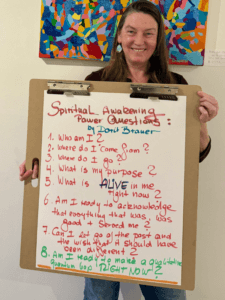
Regulating one’s own emotions and responses means rising up the emotional scale. It’s the capacity to clear the filters of consciousness and grow the ability to align with the higher self.
A holistic practitioner teaches clients to regulate their emotions. It is widely recognized that chronic stress and persistent negative emotional states are associated with a higher risk for a range of health problems. This is one reason emotional regulation is central to prevention-oriented care.
It takes the same amount of effort to be miserable or to be happy. One cannot be happy and angry at the same time, at peace or at war at the same time, or hopeful and pessimistic at the same time.
It is a daily task to monitor our emotions to achieve excellent health and reach personal goals.
High-vibration emotions start with strong roots. And if they were not received early on, then the human being must learn to achieve these advanced states of positive mindset through their own effort, thus evolving consciousness above the low-vibration emotions that keep one stuck in the negative loop of victimhood.
Holistic reflexology assists in reaching these goals by connecting the mental, emotional, and physical levels of the human being, and by supporting the client’s movement toward a steadier, clearer inner state—what we might call a higher consciousness in daily life.
The holistic practitioner must understand the driving desires that motivate clients by taking these into consideration when designing a care plan:
- Are their primary emotions fear, anger, and worry?
- Do they feel hurt, insecure, guilty, unworthy, or ashamed?
- Are they filled with grief, desperation, depression, or despair?
- Do they feel powerless?
- Hatred and rage are low-vibration emotions, like anger, and keep a person stuck in projection. Is your client stuck in projection?
- Jealousy, revenge, and vindictiveness create undesirable life experiences—a vicious cycle that repeats itself. Does your client compare themselves to others they perceive as better?
- Does guilt keep your client connected to the past and inhibit the future?
- Is deep sadness an undercurrent that inhibits a client’s life force, stopping them from reaching radiant health?
- Consider that blame, disappointment, frustration, pessimism, criticism, and irritability are all emotions related to the first three chakras and the organ systems of the liver, spleen, and kidneys.
- Holding this map with a holistic mindset supports practitioner neutrality—one of the clearest expressions of A Higher Consciousness in session.
A Mindset for Good Health and Well-Being
Rising up the emotional scale requires a shift from chronic negativity to a positive mindset centered in:
- Inner Peace
- Joy
- Gratitude
- Love
- Beauty
- Passion
- Happiness
- Positive Expectation
- Delight
- Connection
Embarking on a healing journey requires a holistic mindset shift, rising above the negative perceptions that created the dis-ease.
Brauer Institute graduates are equipped to guide clients through this inner evolution, healing past wounds and trauma. They are also trained to help clients rise up the emotional scale and cultivate a positive affect as their default.
Using specific reflexes on the feet, reflexologists help release trauma and restore emotional equilibrium.
Good health and good emotions start with strong roots and a positive outlook on life. Embarking on a holistic healing journey requires a change in mindset—and changing the perception that created the dis-ease. The first step in healing is moving up your emotional scale and learning to transcend fear, anger, and worry, cultivating a place of inner peace where you feel grounded and fully resourced.
Reflexology is an excellent modality for grounding and feeling safe in the physical body, which, over time and with ongoing sessions, can translate into feeling safer in the world and building trust. With repeated sessions, that trust can become the soil where deeper awareness takes root.
Conclusion
A higher consciousness is not a lofty ideal reserved for rare spiritual moments. It is the lived capacity to stay grounded, regulated, and ethically clear in the presence of another person’s pain.
With a holistic mindset, holistic professionals strengthen their own roots, reduce projection, and practice neutrality, creating a safer, more effective container for real transformation. Over time, this discipline becomes both professional mastery and professional integrity.
When the practitioner’s inner work is ongoing, clients are more likely to experience emotional balance, embodied trust, and a steady return to grounded inner peace in everyday life.